
How Does a CZ Purlin Roll Forming Machine Work? Complete Guide
CZ purlin roll forming machine works by continuously converting steel coil into C or Z structural profiles through controlled stages of decoiling, leveling, feeding, punching, progressive roll forming, cutting and stacking.
CZ purlin roll forming machine converts flat steel coils into continuous C-shaped and Z-shaped structural purlins through a series of controlled cold-forming operations. A typical production line includes decoiling, leveling, feeding, punching, progressive roll forming, cutting and product discharge or stacking, while automatic C/Z machines can also adjust the forming system to produce different profile sizes.
The actual production speed and configuration depend on the steel thickness, purlin dimensions, punching pattern, cutting method and degree of automation. For this reason, buyers should evaluate a machine based on its complete production process and actual output, rather than its advertised maximum forming speed alone.
How Does a CZ Purlin Machine Work?
The basic working process is:
Steel Coil → Decoiling → Leveling → Feeding → Pre-Cutting → Punching → Roll Forming → Post Cutting → Stacking
The steel coil is first unwound and straightened. The flat strip is then guided into the roll forming section, where multiple roller stations progressively bend the steel into the required C or Z profile. Depending on the machine configuration, holes are punched before or after forming, and the continuous profile is finally cut to the programmed length.
For an automatic C/Z interchangeable machine, the PLC control system can also coordinate profile-size adjustments, punching parameters, cutting length and production quantity through the HMI touchscreen.
Pre-cuting device, it’s standard equipment on our Beenew machines, although some suppliers may not have this device. The advantage of having a front shear is that it saves material,in certain necessary situations, the raw material can be cut off at any time to stop the forming process, preventing material waste.
Automatic stacker is an optional feature and is not included in the standard production line. Customers who want to improve production line efficiency and save on labor costs, can choose automatic palletizing machine.
What Is a CZ Purlin Roll Forming Machine?
CZ purlin roll forming machine is a cold roll forming production line designed to manufacture C-shaped and Z-shaped steel purlins from steel coils.
Unlike a press brake, which bends individual sheets or sections one operation at a time, roll forming continuously feeds a long steel strip through multiple forming stations. Each roller station performs a small amount of bending until the final cross-section is achieved.
C and Z purlins are commonly used as secondary structural members in:
- Steel warehouses
- Industrial buildings
- Workshops
- Commercial buildings
- Agricultural buildings
- Roof framing systems
- Wall girt systems
- Steel construction projects
The main advantage of roll forming is continuous production with consistent profile geometry over long lengths.
How Does a CZ Purlin Roll Forming Machine Work Step by Step?
Complete CZ purlin production line normally follows these stages:
- Coil loading
- Decoiling
- Leveling and straightening
- Material feeding and guiding
- Pre-punching or post-punching
- Progressive roll forming
- Cutting to length
- Run-out and stacking
Each stage has a specific purpose, and the accuracy of the final purlin depends on how well these systems work together.
1. Steel Coil Loading and Decoiling
Production starts with a galvanized steel or carbon steel coil.
The coil is mounted on a decoiler, which supports and releases the material at a controlled speed. Depending on the machine configuration, the decoiler can be manual, motorized or hydraulic.
A hydraulic decoiler is generally more convenient for heavier coils because hydraulic expansion and coil loading reduce manual handling.
The decoiler must maintain stable material feeding. Excessive tension, insufficient tension or uneven coil alignment can affect the forming process and cause profile deformation.
What need to check?
When comparing machines, confirm:
- Maximum coil weight
- Maximum coil width
- Material thickness
- Inner coil diameter
- Outer coil diameter
- Manual or hydraulic expansion
- Coil loading method
- Roller material
- Roller diameter
- Roller station
- Motor power
2. Leveling and Straightening
Steel coils naturally retain curvature after being wound.
Before the material enters the forming section, a leveling unit removes excessive coil curvature and helps create a flatter strip.
This stage is important because poor leveling can contribute to:
- Profile twisting
- Uneven flange dimensions
- Longitudinal bending
- Inconsistent hole positions
- Poor cutting accuracy
The leveling system therefore has a direct relationship with finished purlin quality.
3. Feeding and Material Guiding
After leveling, the steel strip enters the feeding and guiding system.
Guide rollers keep the material centered as it moves toward the forming stations. The feeding system must maintain a stable and consistent strip position because even small lateral deviations can affect the final C/Z profile.
For automatic lines, encoders and PLC controls can monitor material movement and coordinate punching and cutting positions.
4. Punching: How Are Holes Made in C/Z Purlins?
Many structural purlins require holes for bolted connections.
CZ purlin machine can be equipped with a punching system designed to create:
- Web holes
- Flange holes
- Round holes
- Slotted holes
- Connection holes
- Customized hole patterns
There are two common approaches:
Pre-Punching
The steel strip is punched while it is still flat, before roll forming.
Advantages:
- Easier positioning of holes
- Suitable for complex hole patterns
- Flat material provides a stable punching surface
Post-Punching
The profile is formed first and then punched.
Advantages:
- Useful for certain machine configurations
- Can simplify some production lines
- Suitable when punching requirements are compatible with the finished profile
The correct system depends on the purlin design, material thickness, hole pattern and required production speed.
5. Progressive Roll Forming
The roll forming section is the heart of the CZ purlin machine.
The flat steel strip passes through multiple pairs of forming rollers. Each station bends the strip gradually rather than creating the final C or Z shape in one operation.
For example:
Flat Strip → Initial Bends → Web Formation → Flange Formation → Lip Formation → Final C/Z Profile
This progressive bending process distributes deformation across multiple stations and helps maintain a consistent cross-section.
The exact number of forming stations depends on:
- Profile size
- Material thickness
- Material strength
- Flange dimensions
- Lip dimensions
- Machine design
There is no universal “correct” number of rollers for every CZ purlin machine. A buyer should evaluate the complete forming design rather than choosing a machine simply because it has more or fewer stations.
- If you mainly produce standard C‑purlins with web‑only holes: Pre‑punch is your cost‑effective and reliable choice.
- If Z‑purlin flange lap holes, strict dimensional tolerances or thick‑material production are required: Servo post‑punch (flying punch) is strongly suggested.
- Budget‑friendly mixed solution: Use pre‑punch for web holes, and match with an offline independent punching unit for flange holes to balance performance and investment.
Contact us to share your drawing, material thickness and main product range, we will customize the most suitable punching configuration for your roll forming line.
6. How Does the Machine Change From C Purlin to Z Purlin?
This is one of the most important differences between a standard purlin machine and a C/Z interchangeable purlin machine.
A fixed C purlin machine is designed primarily for C-shaped profiles, while a fixed Z purlin machine is designed for Z-shaped profiles.
A C/Z interchangeable machine uses an adjustable forming system that allows the same production line to manufacture both profile types.
Depending on the machine design, C/Z changeover can involve:
- Manual roller adjustment
- Mechanical positioning
- Hydraulic adjustment
- Servo-driven adjustment
- PLC-controlled automatic positioning
In an automatic system, the operator selects the required profile and dimensions through the HMI. The control system then moves the relevant forming components to their programmed positions.
Some current automatic C/Z systems use PLC-controlled adjustment and are designed for changeovers measured in minutes rather than traditional manual tooling changes.
Important: advertised changeover time should always be verified for the buyer’s actual profile range and machine configuration.
7. Cutting the Finished Purlin
After the steel has been formed into the required C or Z profile, the continuous section must be cut into individual purlins.
The cutting system can be hydraulic or flying-cut depending on the machine configuration.
The PLC receives the required product length and coordinates the cutting operation with the line speed.
For example, the production order may specify:
- Profile: C200
- Thickness: 2.0 mm
- Length: 6,000 mm
- Quantity: 500 pieces
The control system can use these production parameters to manage the forming and cutting process.
flying-cut system can cut the profile while the line continues moving, which can help maintain production efficiency.
8. Run-Out and Automatic Stacking
After cutting, finished purlins are transferred to a run-out table or automatic stacking system.
For high-volume production, automatic stacking reduces manual handling and helps organize finished products for:
- Bundling
- Packaging
- Storage
- Forklift handling
- Truck loading
A complete automated line can therefore reduce the amount of manual work required after forming.
What Are the Main Components of a CZ Purlin Machine?
Complete production line may contain the following systems:
| Component | Main Function |
|---|---|
| Decoiler | Holds and unwinds steel coil |
| Leveling unit | Removes coil curvature |
| Feeding system | Controls material entry |
| Guide system | Keeps strip aligned |
| Punching unit | Creates connection holes |
| Roll forming stations | Forms the C/Z profile |
| Hydraulic system | Powers punching/cutting functions |
| Cutting system | Cuts purlins to length |
| PLC control | Controls production logic |
| HMI touchscreen | Allows operator input |
| Encoder | Measures material movement |
| Run-out table | Transfers finished purlins |
| Stacker | Collects finished products |
The exact configuration varies according to the required profile range and automation level.
What Is the Difference Between a C Purlin and a Z Purlin?
C and Z purlins are both cold-formed steel structural sections, but their geometry and typical connection methods are different.
| Feature | C Purlin | Z Purlin |
|---|---|---|
| Cross-section | C-shaped | Z-shaped |
| Typical connection | End-to-end | Often lapped |
| Common application | Wall girts and framing | Roof purlins and multi-span structures |
| Installation | Relatively straightforward | Requires correct orientation and overlap |
| Production | Fixed or interchangeable machine | Fixed or interchangeable machine |
The choice between C and Z should ultimately be based on the structural engineer’s design, loading conditions, span, connection requirements and applicable building standards.
A roll forming machine manufacturer should therefore manufacture the profile according to the customer’s approved drawings rather than deciding the structural application independently.
What Materials Can a CZ Purlin Machine Process?
CZ purlin machines commonly process cold-formed steel materials such as:
- Galvanized steel
- Pre-galvanized steel
- Carbon steel
- Structural steel
- High-strength steel, when the machine is designed for it
The allowable thickness depends on the machine’s forming capacity.
A typical machine may be designed around a range such as 1.0–3.0 mm, but heavier-duty machines can be configured for thicker materials. Current manufacturer specifications show significant variation, so buyers should verify the exact thickness, yield strength and profile combination rather than relying on a generic specification.
What Is the Production Speed of a CZ Purlin Machine?
Production speed is one of the most misunderstood specifications when comparing purlin machines.
A manufacturer may publish a forming speed, but the actual production output can be lower when the line is performing punching, cutting and other operations.
For example:
Advertised forming speed ≠ guaranteed finished-product output
Actual production speed depends on:
- Material thickness
- Steel strength
- Purlin dimensions
- Punching quantity
- Hole pattern
- Cutting method
- Product length
- Machine configuration
- Required dimensional accuracy
Some current machines publish forming speeds around 25–30 m/min, while other systems advertise higher speeds. One manufacturer, for example, specifies 0–25 m/min forming speed but 12–18 m/min production speed depending on punching quantity.
Therefore, when requesting a quotation, ask:
“What is the actual production speed for my profile, thickness, hole pattern and finished length?”
This is more useful than simply asking for the maximum machine speed.
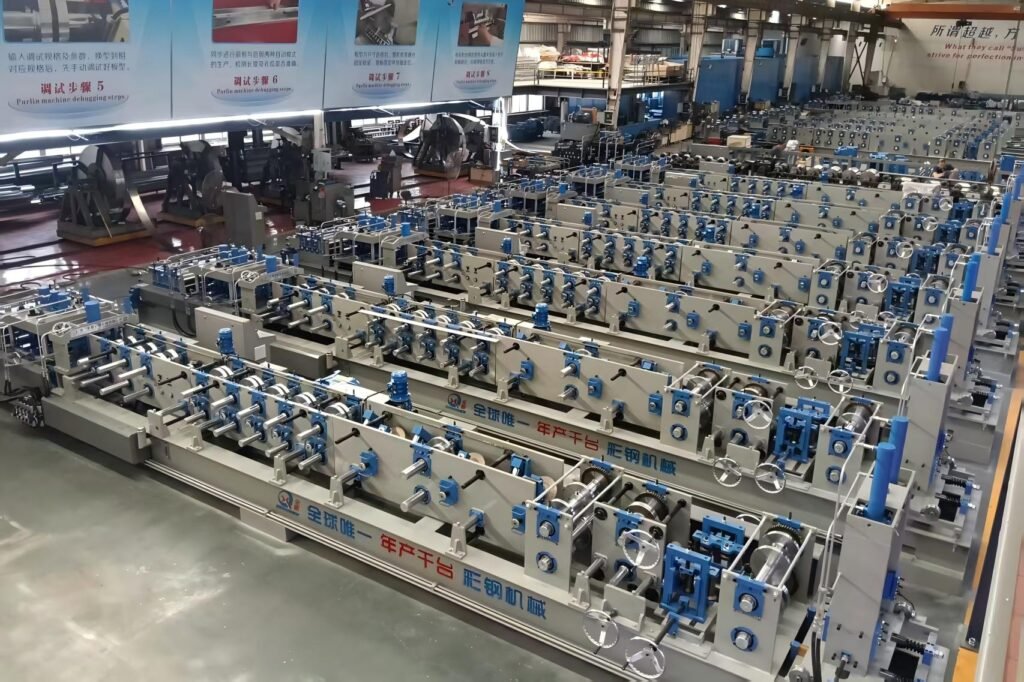
Beenew Purlin Machine
What Is an Automatic CZ Purlin Machine?
An automatic CZ purlin machine uses PLC-controlled mechanisms to automate profile adjustment and production parameters.
Depending on the design, the operator can enter:
- C or Z profile
- Web height
- Flange width
- Lip size
- Material thickness
- Product length
- Quantity
- Punching pattern
The machine then uses programmed settings to coordinate the forming and production process.
Automatic size adjustment is particularly useful for manufacturers producing multiple purlin sizes in relatively small batches.
Automatic vs Fixed CZ Purlin Machine
| Feature | Fixed Machine | Automatic C/Z Machine |
|---|---|---|
| Initial investment | Lower | Higher |
| Profile flexibility | Limited | High |
| C/Z interchange | Usually unavailable | Available |
| Size adjustment | Manual | Automatic or semi-automatic |
| Changeover | More manual work | Faster |
| Best for | Repetitive production | Multi-size production |
| Operator involvement | Higher | Lower |
A fixed machine can be a sensible choice if a factory produces one profile continuously.
An automatic interchangeable machine becomes more attractive when production involves multiple C and Z sizes and frequent order changes.
What Determines the Price of a CZ Purlin Roll Forming Machine?
There is no single standard price for a CZ purlin machine because machine configuration can vary significantly.
The main price factors are:
1. Profile range
A machine designed for C100–C200 is generally less demanding than one designed for a much wider profile range.
2. Material thickness
Thicker steel requires stronger forming components, shafts, frames and drive systems.
3. C/Z interchangeability
Automatic C/Z production requires a more complex adjustable forming system than a fixed-profile machine.
4. Punching system
The number of punching positions and the required hole pattern can significantly affect the machine configuration.
5. Automation
PLC-controlled automatic adjustment, servo systems and automatic stacking can increase the initial investment.
6. Coil handling
A heavier hydraulic decoiler and coil-loading system may be necessary for thicker material.
7. Cutting system
Hydraulic and flying-cut configurations have different performance and cost characteristics.
For this reason, a professional quotation should be based on the profile drawing, steel specification, punching drawing, finished length and expected production capacity.
How to Choose the Right CZ Purlin Machine
Before purchasing a machine, define these specifications first.
1. Confirm the Purlin Profile
Provide the manufacturer with a technical drawing showing:
- Web height
- Flange width
- Lip height
- Profile angle
- Material thickness
2. Confirm the Material
Specify:
- Steel type
- Thickness
- Yield strength
- Coil width
- Coil weight
3. Define C/Z Requirements
Decide whether you need:
- C only
- Z only
- C and Z
- Multiple C/Z sizes
- Automatic C/Z changeover
4. Define Punching Requirements
Provide the exact hole:
- Diameter
- Shape
- Position
- Spacing
- Quantity
- Web/flange location
5. Define Production Capacity
Do not simply say “high speed.”
Instead, specify:
20,000 meters/month
or:
500 pieces/day
or another measurable target.
The manufacturer can then recommend a suitable line configuration.
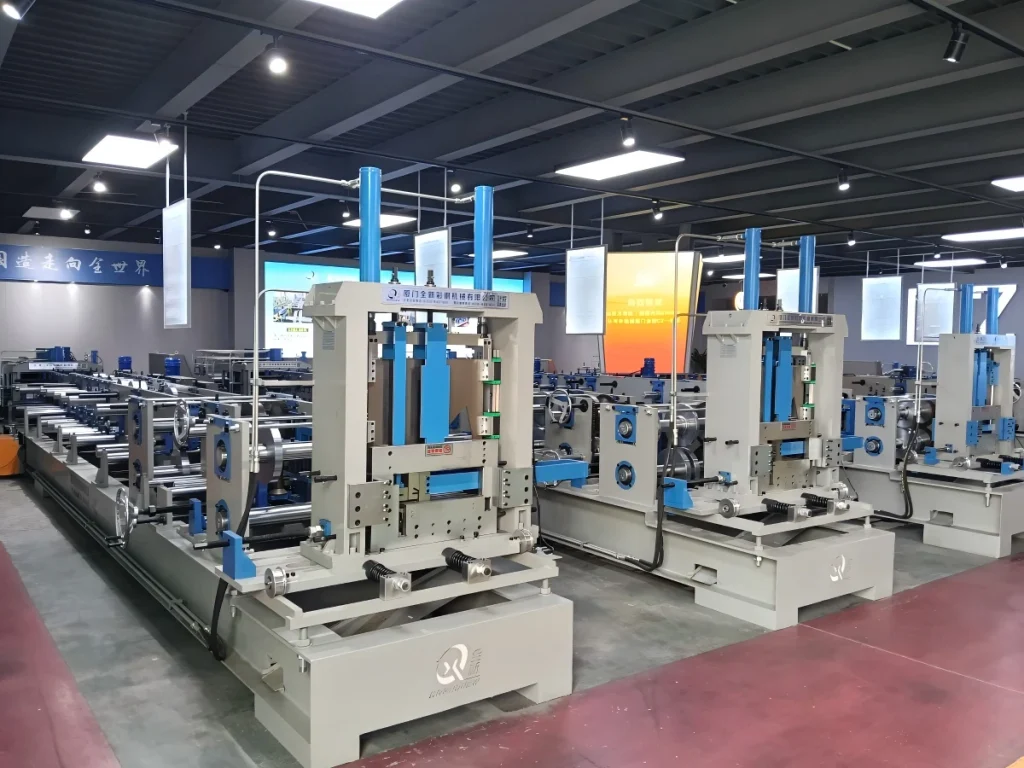
Beenew Purlin Roll Forming Machine
What Should You Ask a CZ Purlin Machine Manufacturer?
Before placing an order, ask these questions:
- What is the complete C/Z profile range?
- What is the maximum material thickness?
- What steel yield strength can the machine process?
- What is the actual production speed with punching?
- Can the machine produce both C and Z profiles?
- How is C-to-Z changeover performed?
- How long does a typical size change take?
- Is punching performed before or after forming?
- What hole patterns can the machine produce?
- What cutting accuracy can be achieved?
- What PLC and electrical components are used?
- Can the manufacturer test my actual profile before shipment?
- Is installation included?
- What is the warranty period?
- What technical support is available after installation?
A serious manufacturer should be able to provide a detailed technical proposal rather than only a machine price.
With nearly 30 years of experience in manufacturing roll forming machines, Beenew Machinery has extensive experience in helping customers select the right machine.
Common Problems During CZ Purlin Production
Understanding the machine process also helps operators identify production problems.
Problem 1: Purlin twisting
Possible causes include:
- Incorrect roller alignment
- Poor leveling
- Uneven material
- Incorrect forming setup
Problem 2: Uneven flange dimensions
Possible causes include:
- Incorrect roller adjustment
- Material deviation
- Roller wear
- Incorrect profile settings
Problem 3: Hole position deviation
Possible causes include:
- Incorrect encoder calibration
- Feeding slip
- Incorrect punching parameters
- Material movement during punching
Problem 4: Length inconsistency
Possible causes include:
- Encoder error
- Feeding slip
- Incorrect cutting settings
- Material deformation
Problem 5: Surface scratches
Possible causes include:
- Damaged rollers
- Incorrect roller clearance
- Foreign material on the forming system
- Poor roller surface condition
These problems demonstrate why machine design, roller precision, control systems and commissioning are all important when evaluating suppliers.
Why Roll Forming Is Suitable for C/Z Purlin Production
Roll forming offers several advantages for continuous purlin production:
- Continuous production
- Consistent cross-section
- High material utilization
- Repeatable dimensions
- Integrated punching
- Automatic cutting
- Reduced manual handling
- Suitable for long production runs
- Easy integration with PLC automation
For manufacturers producing multiple profiles, an interchangeable C/Z system can also reduce the need for separate production equipment.
CZ Purlin Machine Applications
C/Z purlins produced by roll forming machines are commonly used in:
Steel Warehouses
Purlins support roof and wall cladding systems in warehouse structures.
Industrial Buildings
Factories and workshops often require multiple purlin sizes according to structural design.
Agricultural Buildings
Purlins are used in agricultural structures such as storage buildings and farm facilities.
Commercial Buildings
Cold-formed steel purlins can form part of secondary structural framing systems.
Roof Systems
Z and C purlins can support roof panels and related building components.
Wall Girts
C purlins are commonly used as horizontal wall framing members.
Why Choose a C/Z Interchangeable Purlin Machine?
A C/Z interchangeable machine is most useful when production requirements change frequently.
Instead of operating separate C and Z production lines, a properly designed interchangeable system can manufacture both profiles using one integrated line.
The main potential benefits are:
- One production line for C and Z
- Reduced floor-space requirements
- Lower equipment duplication
- Faster product changeover
- Better flexibility for small production batches
- Easier production scheduling
However, interchangeable machines are generally more complex than fixed-profile machines. If a factory only produces one profile in very large quantities, a dedicated machine may still be the better economic choice.
BEENEW CZ Purlin Roll Forming Machine
BEENEW provides roll forming equipment for C/Z purlin production and can configure the production line according to the customer’s required profile dimensions, material thickness, punching pattern, cutting length and automation level.
The machine configuration can be adapted for different C and Z profile requirements, including automatic control, punching and cutting systems.
For a quotation, buyers should provide the C/Z profile drawing, material thickness, steel grade, punching drawing, required length and target production capacity. These specifications allow the manufacturer to recommend the forming system and automation level more accurately.
CZ Purlin Roll Forming Machine FAQ
What is a CZ purlin roll forming machine?
A CZ purlin roll forming machine is a continuous cold-forming production line that converts steel coils into C-shaped and Z-shaped structural purlins. The line can integrate decoiling, leveling, punching, roll forming, cutting and stacking.
How does a CZ purlin machine work?
The steel coil is unwound, leveled and guided into the forming section. Multiple roller stations progressively bend the flat strip into a C or Z profile, after which the finished section is punched, cut to length and discharged.
Can one machine make both C and Z purlins?
Yes, a C/Z interchangeable roll forming machine can be designed to produce both profiles. The available size range and changeover method depend on the specific machine configuration.
How thick can a CZ purlin machine form?
Many commercial machines are designed for approximately 1.5–3.0 mm steel, while other configurations can process thicker material. The actual capability depends on the profile size, steel strength and machine design.
What is the production speed of a CZ purlin machine?
Production speed varies according to material thickness, profile dimensions, punching pattern and cutting method. A machine advertised at a particular forming speed may have a lower actual finished-product speed when punching is included.
Does a CZ purlin machine punch holes automatically?
It can. Depending on the production line, punching may be performed before or after roll forming, and the system can be configured for web holes, flange holes, slots and customized patterns.
How long does it take to change from C to Z?
Changeover time depends on the machine design. Automatic C/Z systems can perform profile adjustment in minutes, while conventional manual systems require more operator intervention. The supplier should confirm the changeover time for the actual profile range being purchased.
What is the difference between a C purlin and a Z purlin?
C purlins have a C-shaped cross-section and are commonly connected end-to-end. Z purlins have a Z-shaped cross-section and are often used with overlapping connections in multi-span structural applications.
Is an automatic CZ purlin machine worth buying?
It can be worthwhile for manufacturers producing multiple C and Z profiles or frequently changing product sizes. For factories producing one fixed profile in very large batches, a dedicated machine may provide a lower-cost solution.
What information should I send when requesting a quotation?
Send the manufacturer your profile drawing, material thickness, steel grade or yield strength, punching drawing, required finished lengths, production quantity and preferred automation level. These details are more useful than requesting a generic “CZ purlin machine price.”
Beenew Purlin Machine
The most important factors when selecting a machine are not maximum speed alone. Buyers should compare profile range, material thickness, punching capability, actual production speed, C/Z changeover method, dimensional accuracy, automation, machine construction and after-sales support.
For manufacturers producing multiple C and Z profiles, an automatic interchangeable machine can provide greater production flexibility than separate fixed-profile machines. The best configuration should always be selected from the actual purlin drawings and production requirements rather than from a generic machine specification.
Beenew Machinery has been manufacturing roll forming machines for nearly 30 years, producing more than 300 purlin forming machines annually. Contact us for a suitable purlin roll forming machine solution.
One Comment